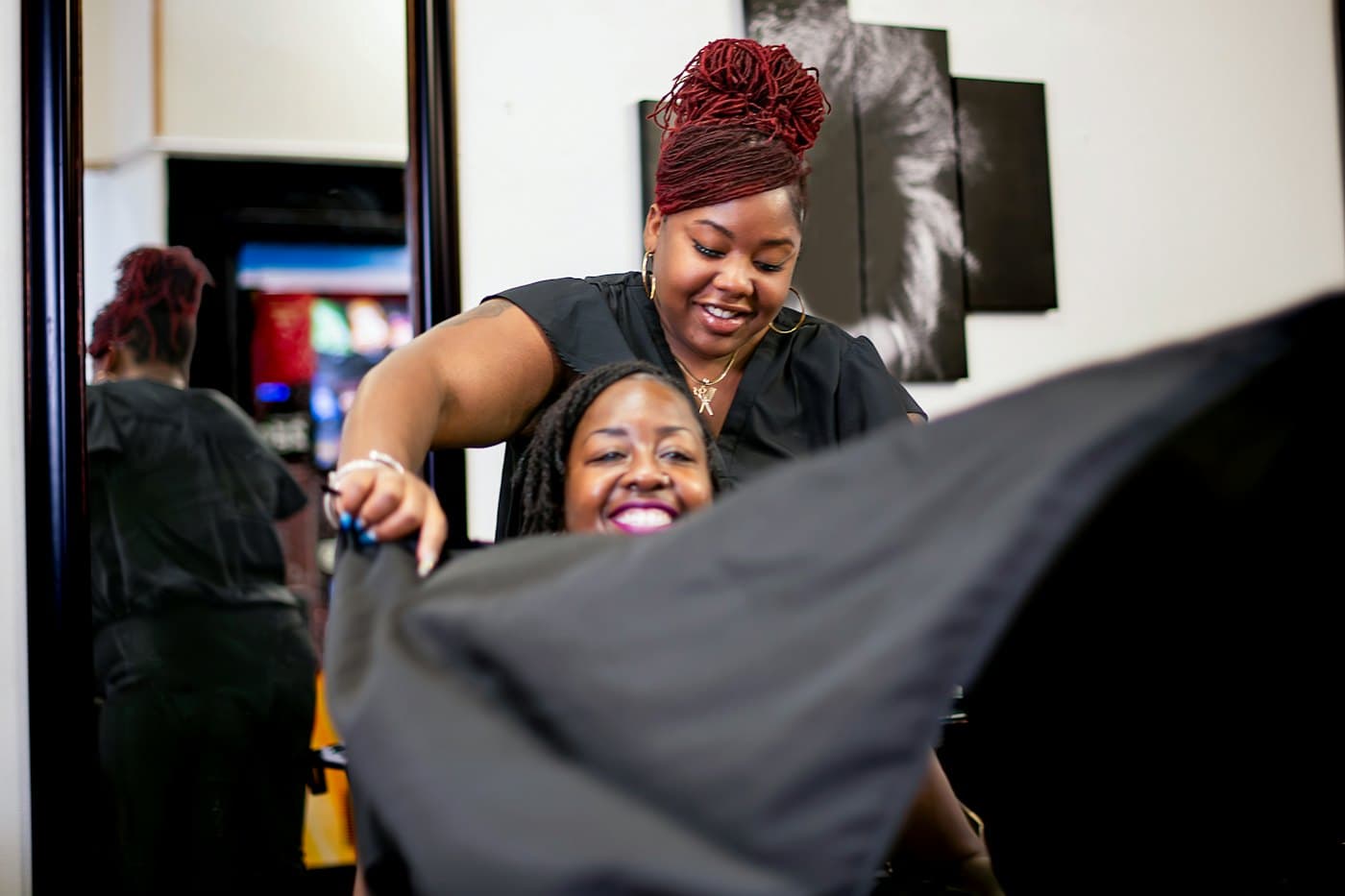
Who insures a salon depends on how its chairs are filled. In a commission or hourly salon the stylists are your employees, so your general liability, professional liability and workers’ comp cover their work and their injuries, subject to each policy’s terms; in a booth rental salon each renter runs a separate business, which means they usually need their own general and professional liability while you insure the salon’s contents, the shared areas and anyone on your payroll.
There’s a catch, though, and it’s the reason this page exists: the agreement you sign with a stylist doesn’t settle which arrangement you have, because how the salon actually runs day to day does. For the policies a salon usually carries, see insurance for salons.
Key takeaways
- Commission and hourly stylists are generally employees, so the salon’s policies, including workers’ comp where your state requires it, cover their work.
- Booth renters are generally separate businesses that need their own general liability and professional liability.
- The IRS looks at who sets the hours, the prices and the appointments to judge whether a stylist is a renter or an employee, and calling someone a renter doesn’t make them one.
- A salon with renters should collect a current certificate of insurance from each one, ideally naming the salon as an additional insured.
- Professional liability is the policy that typically responds when a treatment goes wrong, such as a color reaction or a chemical burn.
Who insures what in each setup
| What happens | Commission or hourly salon | Booth rental salon |
|---|---|---|
| A client trips on a dryer cord in the shared waiting area | The salon’s general liability | The salon’s general liability, since the owner controls the common area |
| A client trips on a cord at a renter’s station | The salon’s general liability | Often the renter’s general liability, and the client may name the salon too |
| A color treatment burns a client’s scalp | The salon’s professional liability | The renter’s professional liability |
| A stylist strains a wrist after a ten-hour day | The salon’s workers’ comp, under your state’s rules | The renter’s own responsibility, since the salon’s workers’ comp generally doesn’t cover renters |
| A pipe bursts and ruins the stations and dryers the salon owns | The salon’s commercial property | The salon’s commercial property |
| The same pipe ruins a renter’s own shears, irons and retail stock | Doesn’t apply | The renter’s own property coverage, if they have it |
Every row is subject to each policy’s terms, limits and exclusions. The pattern is what matters, though: in booth rental, the renter’s work and the renter’s things are usually the renter’s to insure, and the salon keeps the floor, the front desk and the building’s contents.
The agreement doesn’t decide it
Plenty of salon owners sign a booth rental agreement, collect weekly rent and assume the question is closed. It isn’t, and the IRS has written down exactly why, in a short publication written with this industry in mind.
Its tax guide for the cosmetology and barber industry, Publication 4902, describes a booth renter as someone who leases space from an existing business and runs their own business as an independent contractor. It then lists the signs of that: having a key to the building, setting your own hours, buying your own products, having your own phone number and business name, and setting your own prices. If those factors aren’t present, the publication says, the stylist is likely an employee of the business providing the space.
It also gives owners a set of questions to ask themselves, and they’re blunt. Who sets the hours the shop is open, and who decides who works which shifts? Do the workers buy their own supplies with their own money? Who sets the prices customers pay, who books the appointments, and who pays for things like insurance and advertising? The guide adds that if you give extensive instructions about how, when or where to do the work, you’re more than likely the employer.
Now here’s the part that matters for insurance. A salon that books every appointment through its own front desk, prints one price list for every chair and supplies the color line is, by that description, running something that looks a lot like employment, whatever the paperwork calls it. If one of those “renters” develops tendinitis or inhales fumes on the job, they may end up as your workers’ comp claim, and a premium audit can add them to your payroll after the fact, so the premium for them can still arrive as a bill at the end of the term.
That’s the federal tax view, and your state may use its own test for workers’ comp, which can be stricter or simply different. Check with your state’s workers’ comp agency through the U.S. Department of Labor’s list, and if you want renters to stay renters, run the salon like a landlord: let them keep their own books, their own prices and their own clients. Do independent contractors need workers’ comp? goes further into misclassification.
Professional liability for the chair
A claim like that starts at the chair. A lightener left on too long, a relaxer that burns, a dye reaction, a clipper nick, a wax that lifts skin. Professional liability is the policy that typically responds to claims that a treatment went wrong, and it can include your legal defense and, depending on the policy, corrective treatment, subject to its terms, while general liability handles the trips, the falls and the coat that got bleach on it. General liability vs. professional liability lays out the split.
The people doing the work face chemical risks too. OSHA warns that some hair smoothing products contain formaldehyde, including some labeled formaldehyde-free, and that it can be released when the product is heated by a flat iron or blow-dryer, at levels that can irritate the nose, throat and lungs. For your employees, an illness from work like that can fall under workers’ comp, subject to your state’s rules, whereas a renter breathing the same air at the next chair would need to have arranged their own coverage well before the first smoothing treatment of the day.
What to require from booth renters
Put the requirements in the booth rental agreement, and have a lawyer look at it before the first renter signs. A typical list:
- General liability at limits that match or exceed what your lease requires of you.
- Professional liability for the services they perform.
- The salon named as an additional insured on the renter’s general liability, so the salon is covered under the renter’s policy for claims arising from the renter’s work.
- A certificate of insurance before their first day, and a new one at every renewal.
- Workers’ comp if the renter hires an assistant or a shampoo tech, as their state requires.
Your own lease sits above all of this, however. It very likely requires you to carry general liability and to name the landlord as an additional insured, and some leases also say that anyone operating in the space, renters included, must carry insurance, so read that clause before you bring anyone in and pass at least the same requirements down to each renter. The guide to insurance requirements in a commercial lease walks through the usual clauses. Tell your own insurer that you have renters, and how many, because a salon policy is underwritten on that answer, and check that every service on your menu, like extensions, lashes, waxing or smoothing treatments, is one your professional liability actually lists.
Your commercial property coverage should include everything the salon owns: chairs, dryers, shampoo bowls, the front desk and your own retail stock. It typically won’t include a renter’s tools or products unless your policy specifically extends to property of others, so don’t count on it.
If you’re the one renting the booth
So what do you actually need when the chair is yours to rent? Start from the fact that you’re the business, even if your name isn’t on the door.
A typical setup is general liability for injuries and damage, professional liability for treatment claims and property coverage for your own tools and products at the station, plus a look at how that property coverage treats your kit when you take it to a wedding or a client’s home, and the salon owner will likely ask to be named on your policy. Barbers renting a chair face the same split, and barbershop insurance covers the blade work in more detail. With Corgi, a certificate is available the day you buy, and you can download it or send it to the salon owner from your account; if the owner’s agreement asks for a higher limit than you have, limits can be raised the same day.
See what professional liability costs for your business
About five minutes, all online. Your certificate is ready the day you buy.
Salons with both renters and employees
Mixing the two works, but only if you keep the lines sharp.
A salon can run a few employees, say an assistant and a front-desk manager, alongside a row of renters. Use separate written agreements for each group, run payroll only for employees, report only employee payroll at audit and keep each renter’s current certificate on file to show the auditor. If someone moves from renter to commission, or the other way, update the agreement and your policy in the same week, because an auditor who finds a former renter on your payroll with no matching change to the policy will ask questions you’d rather answer in advance.
Frequently asked questions
Does the salon’s insurance cover booth renters?
Usually not for their own work. A salon’s general and professional liability typically cover the salon and its employees, while booth renters are generally separate businesses that need their own coverage, though the salon’s policy may still respond to claims about areas the salon controls, subject to its terms.
Do booth renters need professional liability insurance?
Most do. Claims that a cut, color or chemical service went wrong typically fall under professional liability, and it’s a reasonable condition to write into the booth rental agreement before a renter starts.
Can I require booth renters to name my salon as an additional insured?
Yes. You can make it a condition of the booth rental agreement. The renter’s insurer adds the salon by endorsement, and the renter’s certificate of insurance should show it, so ask for an updated certificate at each renewal.
Do I need workers’ comp if all my stylists rent booths?
It depends on whether they’re truly renters under your state’s rules, and on whether you have any employees, such as a receptionist. True renters are generally not your employees, but if you control their hours, prices and bookings, your state may treat them as employees anyway.