Insurance for restaurants and cafés
Most restaurants start with general liability and property, then add workers’ comp with the first hire. Here’s what each one answers in a kitchen, and what your landlord will ask to see.
- Usually starts with
- General liability and property
- Often asked for by
- Landlords and event venues
About five minutes. Your certificate is ready the day you buy.

What goes wrong in a kitchen
What happens most often to restaurants, and the policy that answers each one.
- Property
01
A fryer fire on the line
Grease catches, the suppression system goes off, and the fryer, the hood and the night’s stock are ruined. Property insurance can help pay to repair or replace the equipment and stock, subject to your policy’s terms and deductible.
- General liability
02
A slip by the drinks station
Spilled ice or a freshly mopped floor sends a customer down hard. General liability typically covers their medical bills, and your defense if they sue.
- General liability
03
A guest gets sick after a meal
A customer says your chicken salad sent them to urgent care and wants you to pay the bill. Claims that food you served made someone ill usually fall under general liability, which can help pay medical bills and defense costs.
- Workers’ comp
04
A burn or a cut behind the counter
A line cook catches a forearm on the flat-top, or a prep cook’s knife slips. Workers’ comp pays for treatment and part of their wages while they heal, as your state’s rules set out.
- Business income
05
Closed until the hood is replaced
After a kitchen fire, you can’t reopen until repairs pass inspection, and rent and payroll keep coming. Business income can help replace lost income and pay those bills while covered damage keeps you closed.
- Cyber
06
A hacked ordering account
Someone gets into your online ordering or point-of-sale account, and customers’ card details are exposed. Cyber insurance can help pay to notify them, restore your systems and handle the legal costs.
The coverage restaurants carry
In the order most owners buy it. Quote them together and see every limit before you pay.
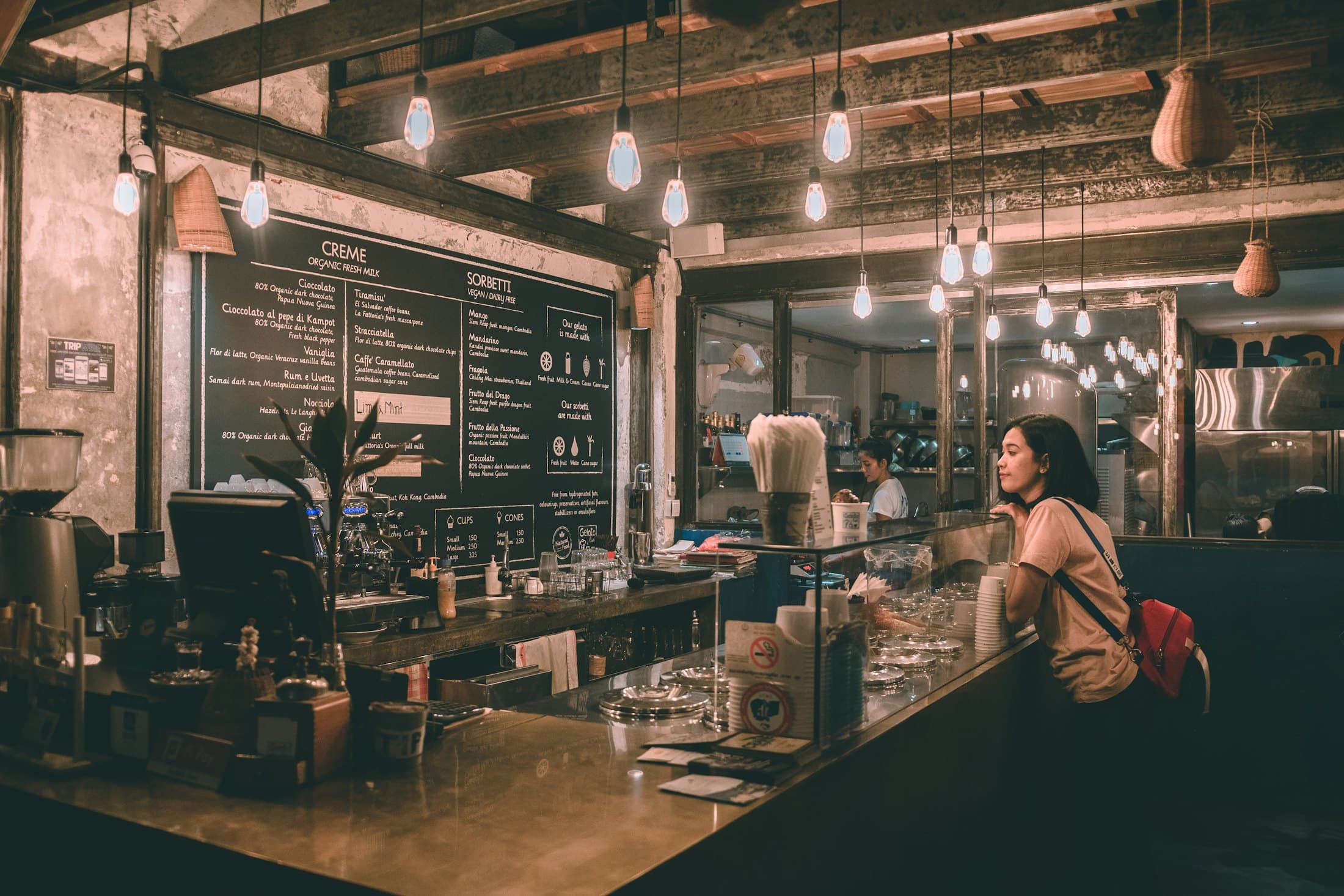
Numbers on the photo match the policies beside it.
- Most carry it01 General liability
Customers walk your floors and eat your food. It answers slips, falls and food-illness claims, and it’s the first thing your landlord asks to see.
$1M / $2M - Most carry it02 Property
Your espresso machine, ovens, walk-in, furniture and stock. Your landlord’s policy covers the building, not what’s inside it.
What you own - Once you hire03 Workers’ comp
Kitchens are full of heat, blades and wet floors. Most states require it once you have employees, and rules vary by state.
Set by state - Often added04 Business income
A fire or a burst pipe can close a kitchen for weeks. It helps cover the income you lose and the bills that don’t stop.
Up to 12 months - If it applies05 Cyber
Worth a look if you take online orders or keep customer details in a point-of-sale or loyalty app.
Up to $250K
Who will ask for proof
Your certificate is ready the day you buy, so you can send it as soon as someone asks.
Landlords
Usually general liability at $1M per claim and $2M a year, with the landlord named as an additional insured. Many leases also ask for property coverage on your build-out and a waiver of subrogation.
Event venues
Venues where you cater often ask to be named as an additional insured for the event date, with the certificate in hand before load-in.
Markets and festivals
Organizers usually ask food trucks and stalls for a general liability certificate naming them, often weeks before the event.
Franchisors
Franchise agreements usually set minimum limits for each policy and ask to be listed as an additional insured.
What moves your price
There’s no price on this page. Your quote is the real number, in about five minutes.
How much does business insurance cost?- 01Whether you fry, grill or cook over open flame
- 02Counter service, full service or a food truck
- 03Your annual sales
- 04Payroll for the kitchen and the floor
- 05The value of your equipment and stock
- 06Your claims history
Keep claims small
Habits that make a claim less likely, and easier to settle when one happens.
Keep the hood clean
Have the hood and ducts cleaned on a schedule and the suppression system inspected. Keep the service records, because insurers may ask for them after a fire.
Mat the wet spots
Put anti-slip mats at the dish pit, the drinks station and the back door, and put out a sign the moment a floor is mopped.
Log your temperatures
Note walk-in and hot-holding temperatures every shift. A log helps you catch a failing cooler, and it helps answer an illness claim.
Write it down that day
When a guest falls or says they got sick, note the time, what happened and who saw it. Then tell your insurer promptly.
Every kind of food business
Choose yours and the quote starts with it filled in.
Guides for restaurant owners
Longer answers to the questions below.
Opening a restaurant: an insurance timeline10 min read Insurance requirements in a commercial lease9 min readHow business income claims are calculated10 min readHiring your first employee: an insurance checklist8 min readFood truck insurance: what you need before your first event9 min readHow business insurance works: premiums, limits and deductibles10 min read
 Additional insured vs. certificate holder9 min read
 Does an LLC need business insurance?9 min read
Questions from
restaurant owners
What insurance do I need to open a restaurant?
Most restaurants start with general liability and property, and add workers’ comp before the first employee starts. Your lease often sets the minimum limits, so read it before you buy. Business income is worth adding if a few weeks closed would be hard to ride out.
Does general liability cover food poisoning claims?
Usually, yes. Claims that food you served made someone sick are typically covered under general liability’s products coverage, subject to the policy’s terms and limits. It can help pay medical bills and your legal defense.
Do I need liquor liability if I serve alcohol?
Often, yes. General liability usually excludes claims from serving alcohol when selling it is part of your business. Liquor liability is a separate policy, not one Corgi offers, and some states and many landlords require it before you can serve.
Does property insurance cover food that spoils in a power outage?
Not always. Many property policies limit or exclude spoilage, especially when the outage starts away from your building. Check your quote for what applies to the walk-in and your stock.
Does a food truck need different insurance?
The kitchen inside a food truck needs the same liability and equipment protection as any kitchen. The truck itself needs commercial auto insurance, which is a separate policy. Markets and events usually want a general liability certificate naming them before you can park.
Is workers’ comp required for part-time staff?
In many states, yes. Part-time and seasonal staff often count toward your state’s threshold. Rules vary by state, so check with your state’s workers’ comp agency before the first shift.
My landlord wants to be an additional insured. Can I do that?
Yes. Most restaurant leases ask for it. With Corgi, your certificate of insurance is ready the day you buy, and you can send it to your landlord from your account.
Get a quote for your kitchen in about five minutes.
Quote General liability, property, workers’ comp and business income together, and see every limit before you buy.